Autoimmunity

Excerpt:

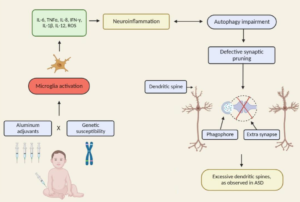
“When assessing adjuvant toxicity in children, several key points ought to be considered: (i) infants and children should not be viewed as “small adults” with regard to toxicological risk as their unique physiology makes them much more vulnerable to toxic insults; (ii) in adult humans Al vaccine adjuvants have been linked to a variety of serious autoimmune and inflammatory conditions (i.e., “ASIA”), yet children are regularly exposed to much higher amounts of Al from vaccines than adults; (iii) it is often assumed that peripheral immune responses do not affect brain function. However, it is now clearly established that there is a bidirectional neuro-immune cross-talk that plays crucial roles in immunoregulation as well as brain function. In turn, perturbations of the neuro-immune axis have been demonstrated in many autoimmune diseases encompassed in “ASIA” and are thought to be driven by a hyperactive immune response; and (iv) the same components of the neuro-immune axis that play key roles in brain development and immune function are heavily targeted by Al adjuvants.”

More
  • January 10, 2012

Excerpt:
“Our results show that: (i) children from countries with the highest ASD prevalence appear to have the highest exposure to Al from vaccines; (ii) the increase in exposure to Al adjuvants significantly correlates with the increase in ASD prevalence in the United States observed over the last two decades (Pearson r=0.92, p<0.0001); and (iii) a significant correlation exists between the amounts of Al administered to preschool children and the current prevalence of ASD in seven Western countries, particularly at 3-4months of age (Pearson r=0.89-0.94, p=0.0018-0.0248). The application of the Hill's criteria to these data indicates that the correlation between Al in vaccines and ASD may be causal."

More
  • August 23, 2011

Abstract
There is a compelling argument that the occurrence of regressive autism is attributable to genetic and chromosomal abnormalities, arising from the overuse of vaccines, which subsequently affects the stability and function of the autonomic nervous system and physiological systems. That sense perception is linked to the autonomic nervous system and the function of the physiological systems enables us to examine the significance of autistic symptoms from a systemic perspective. Failure of the excretory system influences elimination of heavy metals and facilitates their accumulation and subsequent manifestation as neurotoxins: the long-term consequences of which would lead to neurodegeneration, cognitive and developmental problems. It may also influence regulation of neural hyperthermia. This article explores the issues and concludes that sensory dysfunction and systemic failure, manifested as autism, is the inevitable consequence arising from subtle DNA alteration and consequently from the overuse of vaccines.

More
  • July 24, 2009

Excerpts:
“Measles might be etiologically linked to autism because measles and MMR antibodies (a viral marker) correlated positively to brain autoantibodies (an autoimmune marker)–salient features that characterize autoimmune pathology in autism.”

“Conclusions: The scientific evidence is quite credible for our autoimmune hypothesis, leading to the identification of autoimmune autistic disorder (AAD) as a major subset of autism.”

More
  • July 1, 2009

Excerpt:
“In autism, over-zealous neuroinflammatory responses could not only influence neural developmental processes, but may more significantly impair neural signaling involved in cognition in an ongoing fashion.”

More
  • February 21, 2008

Excerpt:

“Recently, it was found that autistic children had a higher mercury exposure during pregnancy due to maternal dental amalgam and thimerosal-containing immunoglobulin shots. It was hypothesized that children with autism have a decreased detoxification capacity due to genetic polymorphism. In vitro, mercury and thimerosal in levels found several days after vaccination inhibit methionine synthetase (MS) by 50%. Normal function of MS is crucial in biochemical steps necessary for brain development, attention and production of glutathione, an important antioxidative and detoxifying agent. Repetitive doses of thimerosal leads to neurobehavioral deteriorations in autoimmune susceptible mice, increased oxidative stress and decreased intracellular levels of glutathione in vitro. Subsequently, autistic children have significantly decreased level of reduced glutathione. Promising treatments of autism involve detoxification of mercury, and supplementation of deficient metabolites.”

More
  • October 1, 2005