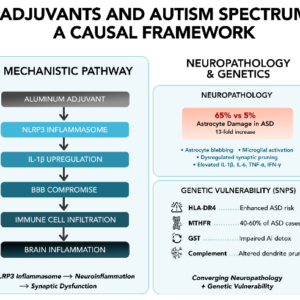
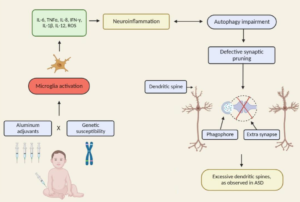
Conclusions: Converging mechanistic, neuropathological, epidemiological, and genetic
evidence demonstrates that aluminum adjuvants can trigger ASD in genetically susceptible
individuals through well-characterized neuroinflammatory pathways. The 80-fold increase
in ASD prevalence temporally correlating with vaccine schedule expansion, combined with
robust biological mechanisms and postmortem findings, demands urgent re-examination of aluminum adjuvant safety in the context of neurodevelopment, particularly in genetically vulnerable populations.
Epidemiology
Field concerned with the determination of causes, incidence, and characteristic behavior of disease outbreaks affecting human populations. It includes the interrelationships of host, agent, and environment as related to the distribution and control of disease. – NLM Medical Subject Headings
U.S. National Library of Medicine, 2025
Excerpt:
“CONCLUSION: Among children born EP, those who had top quartile concentrations of IL-4 and/or IL-10 on postnatal days 21 and/or 28 were more likely than their peers to have low scores on components of the NEPSY-II, OWLS-II, and WIAT-III assessments, as well as identification as having an ASD.”
Excerpt:
“No association was found between preterm birth and NDD in the absence of vaccination, but vaccination was significantly associated with NDD in children born at term (OR 2.7, 95% CI: 1.2, 6.0). However, vaccination coupled with preterm birth was associated with increasing odds of NDD, ranging from 5.4 (95% CI: 2.5, 11.9) compared to vaccinated but non-preterm children, to 14.5 (95% CI: 5.4, 38.7) compared to children who were neither preterm nor vaccinated.”
Excerpts:
“NDD, a derived diagnostic measure, was defined as having one or more of the following three closely-related diagnoses: a learning disability, Attention Deficient Hyperactivity Disorder, and Autism Spectrum Disorder.”
“Vaccinated children were significantly more likely than the unvaccinated to have been diagnosed with the following… ASD (4.7% vs. 1.0%, p = 0.013; OR 4.2, 95% CI: 1.2, 14.5),”
“In conclusion, vaccinated homeschool children were found to have a higher rate of allergies and NDD than unvaccinated homeschool children.”
Abstract
Prenatal and perinatal exposures to air pollutants have been shown to adversely affect birth outcomes in offspring and may contribute to prevalence of autism spectrum disorder (ASD). For this ecologic study, we evaluated the association between ASD prevalence, at the census tract level, and proximity of tract centroids to the closest industrial facilities releasing arsenic, lead or mercury during the 1990s. We used 2000 to 2008 surveillance data from five sites of the Autism and Developmental Disabilities Monitoring (ADDM) network and 2000 census data to estimate prevalence. Multi-level negative binomial regression models were used to test associations between ASD prevalence and proximity to industrial facilities in existence from 1991 to 1999 according to the US Environmental Protection Agency Toxics Release Inventory (USEPA-TRI). Data for 2489 census tracts showed that after adjustment for demographic and socio-economic area-based characteristics, ASD prevalence was higher in census tracts located in the closest 10th percentile compared of distance to those in the furthest 50th percentile (adjusted RR=1.27, 95% CI: (1.00, 1.61), P=0.049). The findings observed in this study are suggestive of the association between urban residential proximity to industrial facilities emitting air pollutants and higher ASD prevalence.
Exerpt:
“Autism spectrum disorder (ASD) is over four times more prevalent in males compared to females.”
Excerpts:
“Febrile seizures represent a serious adverse event following measles, mumps and rubella (MMR) vaccination.”
“In conclusion, using detailed health register information on vaccinations and febrile seizure episodes, we identified common variants at two loci associated with febrile seizures as an adverse event following MMR vaccination. From a public health perspective, it is essential to study the underlying causes of any serious adverse event of the MMR vaccine, a preventive pharmaceutical product given to millions of children each year, and our findings provide important leads for further research in the fields of immunogenetics and vaccinology. Concomitantly, we identified four loci associated with febrile seizures in general, which together with supporting evidence from electrophysiological experiments underline the importance of altered ion channel function in this common childhood disorder. Further functional studies will illuminate the biological mechanisms behind the associations reported here and might also provide more general insights into mechanisms of epileptogenesis and neuronal hyperexcitability.”
Excerpt:
“Autistic disorder change points years are coincident with introduction of vaccines manufactured using human fetal cell lines, containing fetal and retroviral contaminants, into childhood vaccine regimens. This pattern was repeated in the US, UK, Western Australia and Denmark. Thus, rising autistic disorder prevalence is directly related to vaccines manufactured utilizing human fetal cells. Increased paternal age and DSM revisions were not related to rising autistic disorder prevalence.”
CONCLUSIONS:
Autism incidence in California shows no sign yet of plateauing. Younger ages at diagnosis, differential migration, changes in diagnostic criteria, and inclusion of milder cases do not fully explain the observed increases.
Excerpt:
“For example, extreme preterm birth (23-27 weeks of gestation) was associated with infant mortality (odds ratio, 288.1; 95% CI, 271.7-305.5), autism (hazard ratio [HR], 3.2; 95% CI, 2.6-4.0)…”