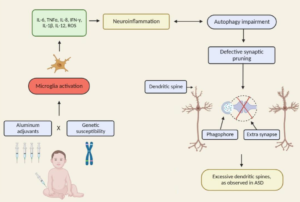
Conclusion
There is now sufficient evidence from both human and animal studies showing that cumulative exposure to aluminium adjuvants is not as benign as previously assumed. Given that vaccines are the only medical intervention that we attempt to deliver to every living human on earth and that by far the largest target population for vaccination are healthy children, a better appreciation and understanding of vaccine adjuvant risks appears warranted.
admin
Excerpt:
“If it is confirmed that autistic children with high fevers are of higher functionality, it is possible for preventive intervention programs to be developed where children are exposed to the least possible chemical drugs intervention (antipyretics, antibiotics, etc.) or even selective vaccination.”
Excerpt:
“Intriguingly, the elevation of anterior pituitary secreting hormones occurred exclusively in male but not in female thimerosal-treated mice, demonstrating for the first time the gender bias of thimerosal-mercury toxicity with regard to endocrine system. Our results indicate that higher dose of neonatal thimerosal-mercury (20× higher than that used in human) is capable of inducing long-lasting substantial dysregulation of neurodevelopment, synaptic function, and endocrine system, which could be the causal involvements of autistic-like behavior in mice.”
Excerpt:
“Evidence from such studies point to a half-life of inorganic mercury in human brains of several years to several decades.”
Excerpt:
“For example, extreme preterm birth (23-27 weeks of gestation) was associated with infant mortality (odds ratio, 288.1; 95% CI, 271.7-305.5), autism (hazard ratio [HR], 3.2; 95% CI, 2.6-4.0)…”
CONCLUSIONS:
The negative adverse consequences on neurodevelopment observed in the present study are consistent with previous studies; this study raised serious concerns about adverse neurodevelopmental disorder such as autism in humans following the ongoing worldwide routine administration of thimerosal containing vaccines to infants.
Excerpt:
“These findings suggest that infantile zinc- and magnesium-deficiency and/or toxic metal burdens may be critical and induce epigenetic alterations in the genes and genetic regulation mechanisms of neurodevelopment in the autistic children, and demonstrate that a time factor “infantile window” is also critical for neurodevelopment and probably for therapy. Thus, early metallomics analysis may lead to early screening/estimation and treatment/prevention for the autistic neurodevelopment disorders.”
Excerpt:
“Our findings suggest that chemicals and genetic mutations that impair topoisomerases could commonly contribute to ASD and other neurodevelopmental disorders.”
Abstract
Emerging research suggests that the timing of environmental factors in the presence of genetic predispositions has influenced the increase in autism spectrum disorders over the past several decades. A review of the medical literature suggests that autism may be impacted by environmental toxicants, breastfeeding duration, gut flora composition, nutritional status, acetaminophen use, vaccine practices and use of antibiotics and/or frequency of infections. The author reports her retrospective clinical research in a general pediatric practice (Advocates for Children), which shows a modest trend toward lower prevalence of autism than her previous pediatric practice or recent CDC data. Out of 294 general pediatrics patients followed since 2005 there were zero new cases of autism (p value 0.014). Given the prevalence of autism for that cohort of 1 in 50 children in the United States, it is important to consider implementing strategies in primary care practice that could potentially modify environmental factors or affect the timing of environmental triggers contributing to autism.
Excerpt
“Male mice in the “high Al” group showed significant changes in light–dark box tests and in various measures of behaviour in an open field. Female mice showed significant changes in the light–dark box at both doses, but no significant changes in open field behaviours. These current data implicate Al injected in early postnatal life in some CNS alterations that may be relevant for a better understanding of the aetiology of ASD.”