AHRQ

Agency for Healthcare Research and Quality (AHRQ) Publication No. 21-EHC024 (2021) https://effectivehealthcare.ahrq.gov/sites/default/files/pdf/cer-244-safety-vaccines.pdf
“This 2021 report is an update to a 2014 report from the Agency for Healthcare Research and Quality (AHRQ). The 2021 update found no new evidence of increased risk since the 2014 report for rare adverse events (severe allergy, seizures caused by fever and blood clotting issues) following administration of routine recommended childhood vaccinations. The AHRQ serves to produce evidence to make health care safer, higher quality, more accessible, equitable and affordable.”
Between 2014 and 2021 there were 72 papers published on the known links between childhood vaccines and the development of autism alone. All of these studies were excluded from the AHRQ 2021 review. This does not include any other papers on the associations between vaccines and other adverse events including severe allergy, seizures, fever, and blood clots.

Excerpts:

“Children with autism spectrum disorders often display dysregulated immune responses and related gastrointestinal symptoms.”

“Our study provides mechanistic insights into why children exposed to heightened inflammation in the womb might have an increased risk of developing inflammatory diseases in addition to neurodevelopmental disorders.”

More
  • December 7, 2021

Abstract

The gut microbiome profile of a child with autism spectrum disorder (ASD) and co-occurring gastrointestinal (GI) symptoms was compared to that of her healthy triplet siblings to determine if she exhibited intestinal dysbiosis. Shotgun metagenomic sequencing was performed in individual fecal samples, and relative microbial abundance and diversity was determined. Microbial diversity was lower in sibling #3, coupled with a higher Bacteroidetes/Firmicutes ratio, a lower relative abundance of Actinobacteria, and an increased relative abundance of Proteobacteria. Our findings are suggestive of gut dysbiosis in a child with ASD and co-occurring GI symptoms, compared to her two healthy triplet siblings.

More
  • November 25, 2020

Excerpt:
“Accumulating evidence implies the gut-brain axis as a pathway for MeHg harmful neurotoxic effects and a potential factor for later neurodegenerative disorders. The MeHg may induce a hormesis-related neuronal toxicity. Hormesis is an important redox dependent aging-associated neurodegenerative/ neuroprotective issue (Calabrese et al., 2010). The use of antioxidants, such as plant polyphenols (Calabrese et al., 2010; Leri et al., 2020) and protective nutrients (Oria et al., 2020) may be beneficial in reducing the MeHg-driven neuroinflammatory state and associated cell death with the interplay of the intestinal microbiota.”

More
  • November 3, 2020

Press Release from Harvard Magazine:

“Inflammation link for autism
A neuroimaging study has shown that the brains of young men with autism spectrum disorder have low levels of translocator protein, a substance that appears to play a role in inflammation and metabolism.

This discovery by a team of HMS researchers at Massachusetts General Hospital provides an important insight into the possible origins of autism spectrum disorder.

This developmental disorder, which affects one in fifty-nine children in the United States, emerges in early childhood and is characterized by difficulty communicating and interacting with others. Although the cause is unknown, growing evidence has linked it to neuroinflammation.

One sign of neuroinflammation is elevated levels of translocator protein, which can be measured in the brain using positron-emission tomography and anatomic magnetic resonance imaging.

The research team used these imaging tools to scan the brains of fifteen young adult males with the disorder. The group included both high- and low-functioning participants with varying degrees of intellectual ability. As a control, the team scanned the brains of eighteen non-autistic young men of similar age.

The scans showed that the brains of the young men with the disorder had lower levels of the protein, compared with the brains of non-autistic participants. In fact, those participants with the most severe symptoms of the disorder tended to have the lowest expression of the protein.

The brain regions found to have low expression of the protein have previously been linked to autism spectrum disorder and are thought to govern social and cognitive capacities such as processing emotions, interpreting facial expressions, and empathy.

The researchers point out that the translocator protein has multiple complex roles, some of which promote brain health. Adequate levels of the protein are, for example, necessary for normal functioning of mitochondria. Earlier research has linked malfunctioning mitochondria in brain cells to autism spectrum disorder.

Zürcher NR et al., Molecular Psychiatry, February 2020

More
  • February 19, 2020

Excerpt:
“Results: A significant and positive correlation was found between hair metal burden (lead, aluminum, arsenic and cadmium levels) and severity of ASD symptoms (social communication deficits and repetitive, restrictive behaviors). Hair zinc level were inversely related with age while there was a negative, significant association between hair zinc level and severity of autistic symptoms (defective functional play and creativity and increase of stereotyped behavior). Lead, molybdenum and manganese hair levels were inversely correlated with cognitive level (full intelligence quotient) in ASD individuals.

Conclusions: The present study suggests the importance to combine metallomics analysis with pertinent disease features in ASD to identify potential environmental risk factors on an individual level possibly in the early developmental period.”

More
  • January 1, 2020

Discussion: The observation of predominantly intracellular aluminium in these tissues was novel and something similar has only previously been observed in cases of autism. The results suggest a strong inflammatory component in this case and support a role for aluminium in this rare and unusual case of CAA.

More
  • April 24, 2019

Except:
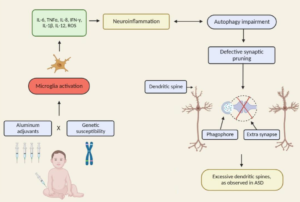
“There is a growing body of work to support the role of inflammatory cytokines in ASD. An emerging focus of research into the etiology of ASD has suggested neuroinflammation as one of the major candidates underlying the biologica model [5]. Plasma levels of IL-1β, IL-6 and IL-8 were increased in children with ASD and correlated with regressive autism, as well as impaired communication and aberrant behavior [6-8]. Vargas [9] showed an active neuroinflammatory process in the cerebral cortex, white matter, and in the cerebellum of autistic patients. Immunocytochemichal studies showed marked activation of microglia [5].”

More
  • January 1, 2019