Regression

Exceprts:
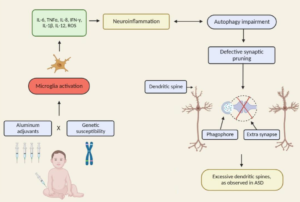
We also discuss evidence implicating oxidative stress, neuroglial activation and neuroimmunity in autism.

“Oxidative stress is another possible cause of Purkinje cell loss and other neuroanatomical changes described in autistic brains (reviewed in (37, 113)). Oxidative stress occurs when the levels of reactive oxygen species exceed the antioxidant capacities of a cell, often leading to cell death. Because of its very high oxygen demands and limited anti-oxidant capacity, the brain is thought to be relatively vulnerable to oxidative stress (111). Several studies have shown decreased levels of antioxidants such as superoxide dismutase, transferrin and ceruloplasmin in the blood or serum of patients with ASD (38, 108, 222). Significant elevations in biomarker profiles indicating increased oxidative stress, such as increased lipid peroxidation, have also been documented in autism (38, 107, 229).Interestingly, in one report the alterations in antioxidant proteins were linked specifically to regressive autism, suggesting a postnatal environmental effect (38). Polymorphisms in metabolic pathway genes may contribute to the increased oxidative stress in autism (108). Advanced glycationend products have also been reported to be elevated in both the brain tissue and serum of autistic patients, a change which can also lead to increased oxidative damage (23,110).”

More
  • October 17, 2007

Excerpt:

“There was a significant dose-response relationship between the severity of the regressive ASDs observed and the total mercury dose children received from Thimerosal-containing vaccines/Rho (D)-immune globulin preparations. Based upon differential diagnoses, 8 of 9 patients examined were exposed to significant mercury from Thimerosal-containing biologic/vaccine preparations during their fetal/infant developmental periods, and subsequently, between 12 and 24 mo of age, these previously normally developing children suffered mercury toxic encephalopathies that manifested with clinical symptoms consistent with regressive ASDs. Evidence for mercury intoxication should be considered in the differential diagnosis as contributing to some regressive ASDs.”

More
  • May 15, 2007

Excerpts:
“Case 3. Richard M. was referred to the Johns Hopkins Hospital on February 5, 1941, at 3 years, 3 months of age, with the complaint of deafness because he did not talk and did not respond to questions.”

“Following smallpox vaccination at 12 months, he had an attack of diarrhea and fever, from which he recovered in somewhat less than a week.”

“In September, 1940, the mother, in commenting on Richard’s failure to talk, remarked in her notes: I can’t be sure just when he stopped the imitation of words sounds. It seems that he has gone backward mentally gradually for the last two years.”

More
  • January 1, 1943