admin

Excerpts:
“This empirical investigation, published in a peer-reviewed law journal, examines claims that the VICP compensated for vaccine-induced encephalopathy and seizure disorder. The VICP has compensated approximately 2,500 claims of vaccine injury since the inception of the program. This study found 83 cases of acknowledged vaccine-induced brain damage that include autism, a disorder that affects speech, social communication and behavior.”

“This finding of autism in compensated cases of vaccine injury is significant. U.S. government spokespeople have been asserting no vaccine-autism link for more than a decade. This finding calls into question the decisions of the Court of Federal Claims in the Omnibus Autism Proceeding in 2009 and 2010 and the statement of Health and Human Services on its website that “HHS has never concluded in any case that autism was caused by vaccination.”

More
  • January 23, 2011

Abstract

Mercury toxicity is a highly interesting topic in biomedicine due to the severe endpoints and treatment limitations. Selenite serves as an antagonist of mercury toxicity, but the molecular mechanism of detoxification is not clear. Inhibition of the selenoenzyme thioredoxin reductase (TrxR) is a suggested mechanism of toxicity. Here, we demonstrated enhanced inhibition of activity by inorganic and organic mercury compounds in NADPH-reduced TrxR, consistent with binding of mercury also to the active site selenolthiol. On treatment with 5 μM selenite and NADPH, TrxR inactivated by HgCl(2) displayed almost full recovery of activity. Structural analysis indicated that mercury was complexed with TrxR, but enzyme-generated selenide removed mercury as mercury selenide, regenerating the active site selenocysteine and cysteine residues required for activity. The antagonistic effects on TrxR inhibition were extended to endogenous antioxidants, such as GSH, and clinically used exogenous chelating agents BAL, DMPS, DMSA, and α-lipoic acid. Consistent with the in vitro results, recovery of TrxR activity and cell viability by selenite was observed in HgCl(2)-treated HEK 293 cells. These results stress the role of TrxR as a target of mercurials and provide the mechanism of selenite as a detoxification agent for mercury poisoning.

More
  • September 1, 2010

Excerpt:
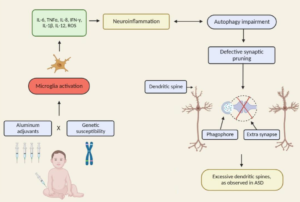
“CONCLUSIONS: The activation profile described represents a neuropathological alteration in a sizeable fraction of cases with autism. Given its early presence, microglial activation may play a central role in the pathogenesis of autism in a substantial proportion of patients. Alternatively, activation may represent a response of the innate neuroimmune system to synaptic, neuronal, or neuronal network disturbances, or reflect genetic and/or environmental abnormalities impacting multiple cellular populations.”

More
  • August 15, 2010

Conclusions: HgCl2 stimulates VEGF and IL-6 release from human mast cells. This phenomenon could disrupt the blood-brain-barrier and permit brain inflammation. As a result, the findings of the present study provide a biological mechanism for how low levels of mercury may contribute to ASD pathogenesis.

More
  • July 20, 2010

CONCLUSIONS:
Among 12- to 23-month-olds who received their first dose of measles-containing vaccine, fever and seizure were elevated 7 to 10 days after vaccination. Vaccination with MMRV results in 1 additional febrile seizure for every 2300 doses given instead of separate MMR + varicella vaccines. Providers who recommend MMRV should communicate to parents that it increases the risk of fever and seizure over that already associated with measles-containing vaccines.

More
  • July 1, 2010

Except:
“These results suggest that maturational changes in amygdala volume and the binding capacity of [11C]DPN in the amygdala was significantly altered in infant macaques receiving the vaccine schedule. The macaque infant is a relevant animal model in which to investigate specific environmental exposures and structural/functional neuroimaging during neurodevelopment.”

More
  • June 30, 2010